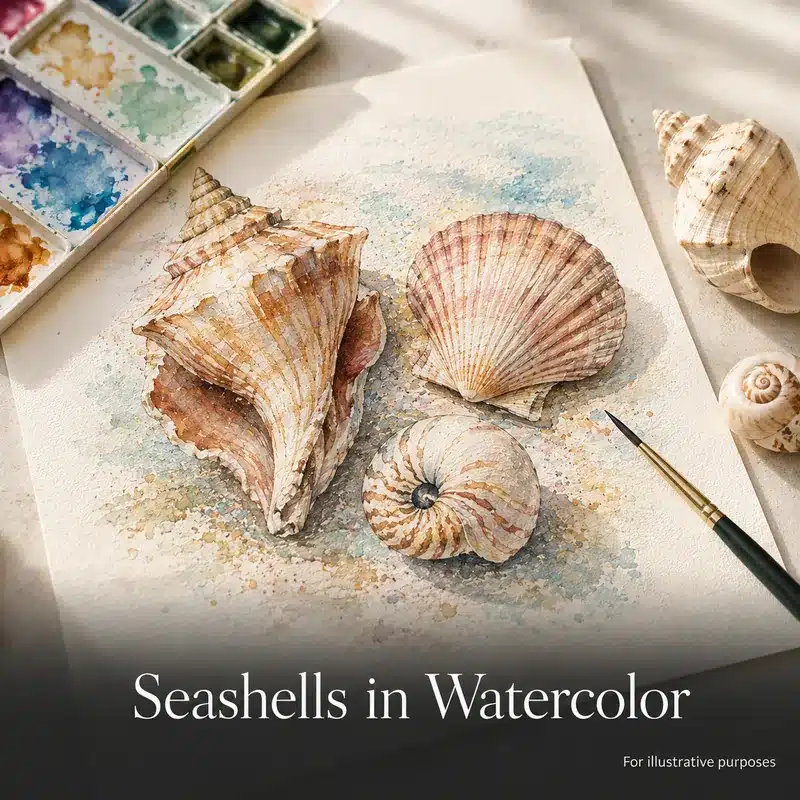
Seashells have fascinated artists for centuries — their spiraling forms, translucent surfaces, and infinite variety of color make them one of the most rewarding subjects in classical still life. Working from real shells, Igor Naskalov teaches you to capture their delicate detail using watercolor and watercolor pencils.
You’ll learn the particular challenges of shells: curved highlights, subtle color gradients, the way light passes through thin areas. You leave with a detailed, jewel-like finished piece.
What you’ll learn
- How to observe and record complex curved forms
- Wet-on-wet watercolor for soft gradients and translucency
- Watercolor pencil techniques for fine detail
- Building layers without muddying colors
What to bring
- Watercolor paint set (12+ colors)
- Watercolor pencils set
- Watercolor paper A3/A4, 180–200gsm (5–10 sheets)
- Soft synthetic brushes #0–8
- HB pencil and eraser
- Disposable palette or white plate
Class size: 8–12 students (minimum 5 to run) · Ages: 12+ · Languages: English · Russian · Italian
Who is Igor Naskalov?
Igor Naskalov is a classically trained Russian painter and one of the foremost instructors of Old Masters techniques working today. He currently serves as Chairman of Painting at the Russian Academy of Painting, Sculpture and Architecture in Moscow – the same institution that has trained generations of Russia’s finest artists – where he also leads student programs at the State Hermitage Museum.
Igor’s teaching takes him across the world. He has led workshops and masterclasses at the Florence Academy of Art in Italy and the Dutch Atelier of Realist Art in Haarlem, Netherlands, working with serious students of painting from Europe, Russia, and the United States. This summer, he completed a program at the Hermitage Museum with 22 students before bringing his work to South Florida.
He is the co-author of Drawing Drapery, an academic instructional book on the history and classical technique of depicting textiles — a staple subject in the European painting tradition.
Igor teaches in English, Russian, and Italian, and his classes are designed to give students of all levels a genuine experience of how the great painters of Europe actually worked — not a simplified version of it, but the real thing, adapted to where you are right now as an artist.