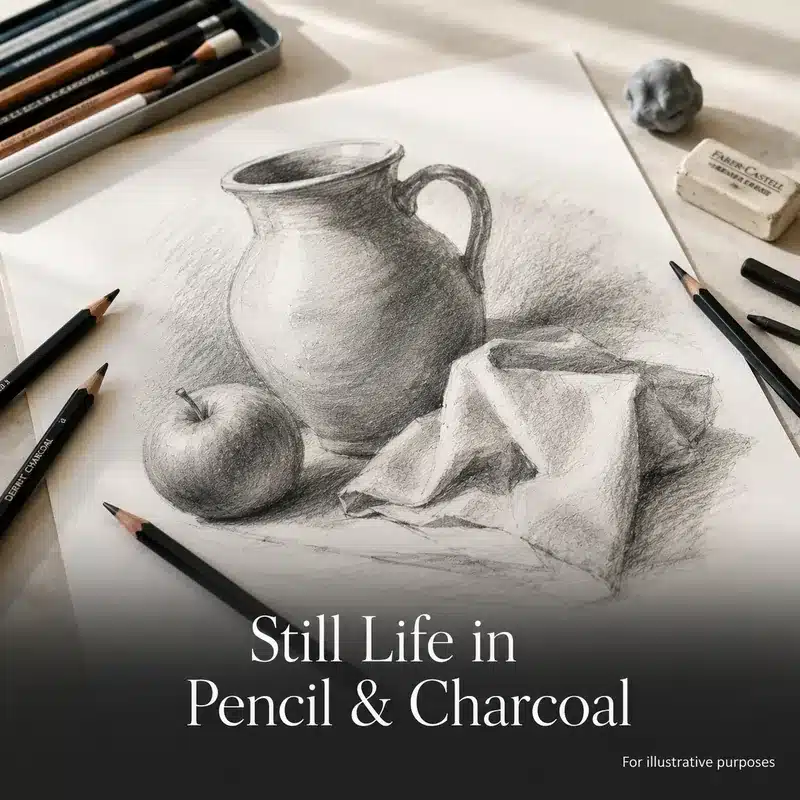
This class introduces the foundational drawing technique used by European masters for centuries: careful observation, precise line work, and the use of light and shadow to give objects dimension and life. Working from a curated still life arrangement, you’ll develop your eye and your hand in a single focused session.
Using graphite pencils and vine charcoal, Igor Naskalov guides you from initial contour lines to a fully shaded, three-dimensional drawing — a skill that transfers to every medium.
What you’ll learn
- Contour drawing and proportion
- How to see and record light, shadow, and form
- Pencil shading and blending
- Working with charcoal for bold, expressive results
What to bring
- Graphite pencils: HB and B
- Vine charcoal sticks
- Drawing paper A3/A4, 180–200gsm (5–10 sheets)
- Kneaded eraser and standard eraser
Class size: 8–12 students (minimum 5 to run) · Ages: 12+ · Languages: English · Russian · Italian
Who is Igor Naskalov?
Igor Naskalov is a classically trained Russian painter and one of the foremost instructors of Old Masters techniques working today. He currently serves as Chairman of Painting at the Russian Academy of Painting, Sculpture and Architecture in Moscow – the same institution that has trained generations of Russia’s finest artists – where he also leads student programs at the State Hermitage Museum.
Igor’s teaching takes him across the world. He has led workshops and masterclasses at the Florence Academy of Art in Italy and the Dutch Atelier of Realist Art in Haarlem, Netherlands, working with serious students of painting from Europe, Russia, and the United States. This summer, he completed a program at the Hermitage Museum with 22 students before bringing his work to South Florida.
He is the co-author of Drawing Drapery, an academic instructional book on the history and classical technique of depicting textiles — a staple subject in the European painting tradition.
Igor teaches in English, Russian, and Italian, and his classes are designed to give students of all levels a genuine experience of how the great painters of Europe actually worked — not a simplified version of it, but the real thing, adapted to where you are right now as an artist.